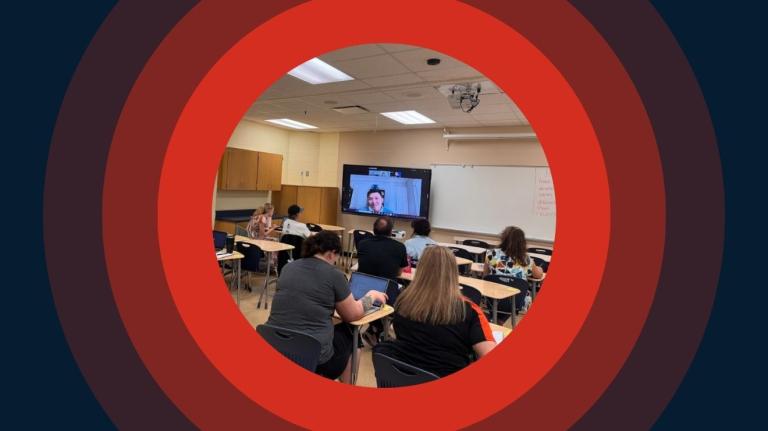
On the main stage at ISTELive 2026, an educator named Brandie Wright told a story about four words: "Are you a mathematician?" She had a student everyone had written off as the goofy athlete. One day, instead of handing him a label, she asked him that question.
Four words without a clear answer or shortcut, and a question that left him sitting with the possibility that he might be someone he'd never pictured. Slow and human, the moment wasn’t optimized, and there wasn’t a chatbot to give him a quick answer. Heading into the 2026-2027 school year, the tension between slow and human vs. AI and optimized in the classroom is worth paying attention to.
The pattern showed up right away at the sessions in Orlando. Nearly every talk about adopting AI had real excitement… and real worry. Underneath the worry sat the idea that learning needs friction, and AI is very good at taking it away. And that's what educators are prioritizing this year. They want to protect the struggle—the pause, the second try, the slow and human attempt, the "let's find another way"—that AI can quickly smooth over.
The struggle AI smooths over (if we let it)
Every teacher and parent knows the moment when a child can’t do something and sits in discomfort. They try again (and again, and again) until something finally clicks. Researchers call that productive friction, and it's where a lot of real learning happens.
An AI-powered chatbot erases that struggle, since you can get a solution in seconds. Googling something walked so asking Chat could run. Do that often enough and the brain leans into cognitive offloading; it stops doing the work it can simply hand to a machine.
Kiera Bridley, an elementary teacher in Wisconsin, talked about one implication of this phenomenon in her ISTE session on learned helplessness.. It grows from repeated failure, but also from too much help—over-scaffolding, over-prompting, answers delivered before a child has to think. A tool that resolves every struggle on demand points straight at it. And while AI isn’t responsible for all learned helplessness, it isn’t helping the cause. Because when the struggle disappears, so does some of the learning.
The evidence behind the worry
It's more than a keynote mood. In a 2026 Common Sense Media survey, 60% of kids and teens—and 71% of parents—said they expect people to depend on AI so heavily they won't be able to function without it. And 83% agreed that kids still need to learn to think for themselves.
The usage is already here. Dr. Yi Zhang shared another Common Sense Media survey that showed 86% of kids ages 9 to 17 use AI, and that 42% of daily users said a month without it would be hard.
The academic research points in the same direction—heavier AI use tends to track with weaker critical thinking—though most of it is correlational, so it hints at a problem without proving one. One ISTELive session made exactly that point: correlation is easy to find and easy to misread.
It’s also difficult to wave off the convergence around the topic. A keynote on productive friction, an elementary session on learned helplessness, a state policy session on how legislators are grappling with what to allow and when regarding screentime and AI, and a district leadership panel insisting that answers are cheap and questions are valuable—and those are just a handful of the 1,000+ sessions. Coming at the same problem from different angles, K–12 leaders and educators are uniting on a similar path forward. None of them were coordinated, and yet all of them landed on the same idea.
The real question for the 2026-2027 school year
The useful question this year is where to keep that productive struggle and where to let AI carry the weight.
Miami-Dade's Jeannette Tejeda drew the line cleanly: AI can carry options, scaffolds, drafts, and planning weight. But it can't carry judgment, trust, or a relationship with a student. Hand it the first list, and teachers get time back, but if you hand it the second, you automate away the part that matters.
Richard Culatta, who leads ISTE+ASCD, offered a similar test: screen value over screen time. The question is whether those minutes ask anything of the student, not how many of them there are. Chris Phillips at Google for Education also pushed the phrase, “teacher in the lead, not the loop.”
The resistance to cognitive offloading looks small in the classroom. Bridley suggests pivots in language like "what have you tried so far?" instead of "let me help you." Small steps to preserve productive friction keep learners at the center of the learning experience (while keeping AI in a healthier place.)
Protect the struggle
None of this means pulling AI out of schools. Used well, it carries real weight for teachers who often have too much to do in too little time and can automate administrative tasks so they can focus more on exceptional learning experiences for students. The work ahead is naming the places where a student benefits from hitting the wall, sitting with it, and finding a way through.
Brandie Wright handed her student a question and the space to wrestle with it. An AI tool built to resolve confusion in seconds would have skipped right past the best thing that happened to him that year. Some tools are more helpful than others at maintaining a healthy struggle. When tools are evidence-backed and built for education, they’re more likely to preserve productive friction and help students grow.
So protect the struggle, because that’s where lifelong learning lives.