
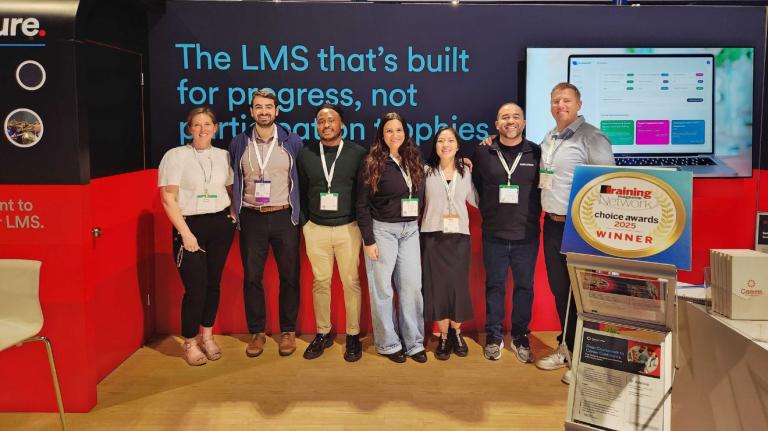
We just got back from Training 2026, and I’m still buzzing from the conversations. There is something uniquely energizing about being in a room with 2,000+ learning leaders who genuinely care about helping their people grow.
But beyond the energy, the candor was real.
Across industries, workforce models, and organizations of all sizes, the themes were remarkably consistent. If we had to distill the state of training in 2026 based on those two days, these are the issues top of mind for L&D leaders:
The "Legacy Fatigue" is Real
Many leaders told us their current LMS platforms were built for an earlier era of learning and are becoming harder to adapt as their programs scale; that these systems feel clunky, unintuitive, and "admin-unfriendly." It’s not a lack of belief in learning; it’s that legacy architecture can't keep up with modern workforce needs. There is a palpable hunger for platforms that feel sleek and intentional—tools that give leaders confidence they can engage learners in ways that feel contemporary and credible.
AI: Utility Over Hype
AI came up in almost every conversation, but not as a buzzword. No one is looking for hype anymore. Small—often one-person—L&D teams are being asked to design, build, and optimize programs with finite resources.
Their demand is simple: AI must reduce the daily lift. What resonated most was the shift toward applied AI. Because we aren’t retrofitting AI into architecture from a decade ago, we’re able to think "AI-first." Leaders don’t want an AI "plugin" slapped onto an old system; they want AI-supported workflows and content generation that actually save time.
The "Stitched Together" Tech Stack
We heard a lot about fragmentation. Most organizations are currently operating with a patchwork of tools: an authoring tool here, a scenario platform there, a separate content library, and various reporting layers all "assembled" into an LMS.
It works technically, but it feels fragile. As technology advances, the expectation is shifting toward cohesion—fewer systems that do more, allowing the experience to feel unified rather than a series of disconnected tabs.
Practice Must Be Immersive
When it came to skills, there was a noticeable shift in tone. Much of the "skills training" in the market still relies on text-based branching and basic multiple-choice questions. But that’s not how people build real capability.
There is a massive opportunity to create richer, immersive practice environments that connect directly to measurable skill attainment. For organizations managing certified or compliance-driven workforces, practice needs to feel real for the outcomes to be clear.
The Theme of 2026: Readiness
Underneath all of these conversations was one word that kept surfacing: Readiness.
Readiness to reskill.
Readiness to certify.
Readiness to adapt.
Readiness for whatever comes next.
Leaders aren't asking whether learning matters anymore. They are asking whether their workforce is truly ready to perform. They expect their learning ecosystem to help them answer that question with absolute confidence.
Training 2026 reinforced a vital truth for us: Organizations aren't looking for more tools. They are looking for clarity, cohesion, and confidence in how learning connects to real business outcomes.
The future of workforce learning will belong to organizations that build systems designed not just to deliver training, but to ensure their people are truly ready for what comes next.
Read more about readiness in the workforce in The State of Learning and Readiness: B-Sides report.
Related Content
 csu_1.jpg
Blogs
 parchment_blog.jpg
Blogs
 csu.jpg
Blogs