A few months ago, I was talking with a university provost who said something that stuck with me - “We’ve had more conversations about AI in the last year than we’ve had about online learning in the last decade. And I’m not sure we’re any closer to knowing what to actually do about it.”
That tension is real
There’s no shortage of energy around AI right now. Faculty are experimenting, and students are already using it in ways that range from impressive to… let’s call it creative. Institutions are forming committees, drafting guidelines, and trying to make sense of a landscape that seems to shift under our feet every few weeks. But when you zoom out, most of that activity still sits in the realm of exploration.
Unfortunately, AI is already impacting the job market we’re preparing many of our students to enter. In a recent LinkedIn post, I shared data from Anthropic showing the job functions we anticipate AI will impact and those that are already being impacted, based on Claude usage data. The future is already here.
That’s exactly why National AI Literacy Day matters
Today, March 27th, marks National AI Literacy Day, a nationwide day of action in the United States focused on exploring the fundamental question, “What is AI?” and “How do we prepare learners for an AI-enabled world?” Because the conversation is truly starting to shift. The question is no longer whether AI belongs in education. It’s whether we’re building the kind of capability that allows it to be used well, consistently, and responsibly by both educators and students.
One of the traps I see leaders falling into is treating this like a tool problem. Which tools are approved? Which ones should be restricted or blocked? How do we keep up with the next evolution? How do we stop students from cheating? It’s understandable, but it’s the wrong level of focus.
Tools will continue to change. What doesn’t change as quickly is how people think about those tools. How they question outputs, understand limitations, and make informed decisions about when and how to use them. That’s the work of AI literacy, and it’s why policy matters far more than any single technology decision.
At its best, AI literacy is not about technical proficiency. It’s about judgment. It’s about helping students and educators understand what AI is doing, where it adds value, where it introduces risk, and how to engage with it in ways that actually support learning. So, how do we do that?
The encouraging part is that we’re starting to see real clarity emerge around what this looks like in practice
Organizations like UNESCO have taken the global lead in developing competency frameworks for both students and teachers that emphasize ethical use, critical evaluation, and co-creation with AI. That dual focus is important because AI literacy doesn’t live in a single course, or program, or institution; it has to be built across the system.
At the same time, leading institutions are developing models that reflect this as a layered, developmental capability. The University of Canterbury’s SAIL framework offers a scaffolded approach that builds proficiency over time, and the Open University highlights accessibility and lifelong learning as central to the conversation. Barnard College has emphasized critical thinking and ethical reasoning across disciplines. Stanford’s work pushes learners to interpret and question AI systems, not just use them. Different models, but a shared direction. AI literacy is not a one-time skill. It’s something that develops with intention.
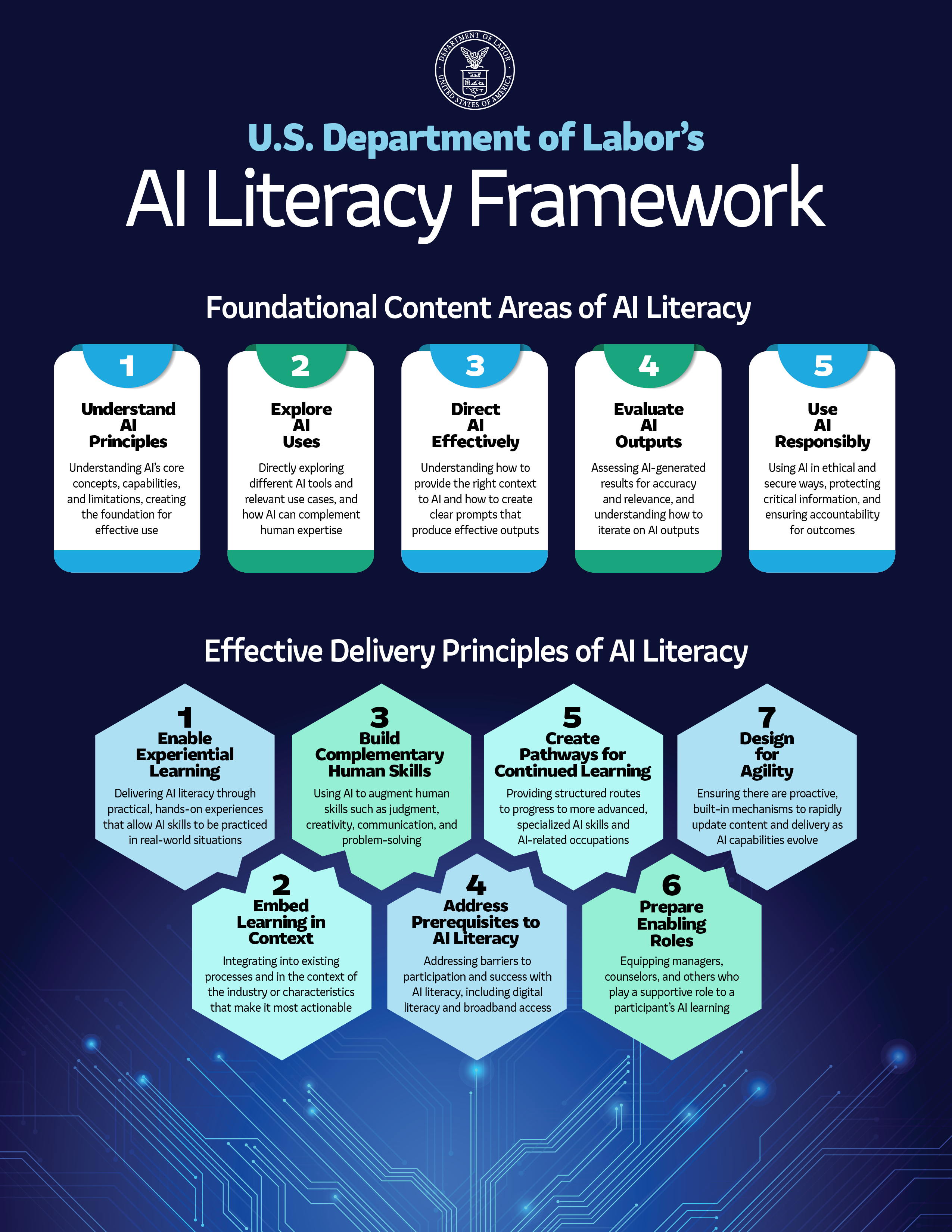
More recently, the U.S. Department of Labor added another important signal with the release of its National AI Literacy Framework. It outlines core areas like understanding AI concepts, using and directing tools effectively, evaluating outputs, and applying them responsibly in real-world contexts.
What stands out is the alignment. For the first time, we’re seeing education, workforce, and policy begin to converge around a shared understanding of what AI literacy actually means. That alignment makes it much easier for educational institutions to move forward with confidence, because this is no longer an isolated conversation; it’s a broader expectation. So where should leaders focus now?
This is the moment to move from curiosity to capability
That starts by recognizing that guidelines alone won’t scale. They’re helpful, but they tend to stay at the surface. Policy is what shapes behavior over time. It influences how courses are designed, how assessment evolves, and how students understand what is expected of them.
It also means treating AI literacy the same way we’ve approached writing, math, or digital fluency. Not as a standalone initiative, but as something that shows up across disciplines, across programs, and across the full student experience.
And maybe most importantly, it requires investing in educators. We can’t expect students to build meaningful AI literacy if faculty are still navigating uncertainty without support. Confidence, shared understanding, and practical application among educators are what ultimately unlock scale.
All of this leads to a simple reality: AI literacy is quickly becoming a foundational skill. Not just the ability to use these innovative tools, but the ability to participate fully in a world where those tools are embedded in how we learn, work, and make decisions.
So on National AI Literacy Day, it’s worth asking a more pointed question - Are we still exploring AI? OR are we building the systems and policies that make AI literacy part of how our institutions will actually operate in the future? Because that’s the line between experimentation and impact.
Happy National AI Literacy Day, everyone!