
Artificial intelligence is transforming higher education. AI tutors are drafting responses, AI tools are summarizing lectures, and AI copilots are appearing inside the LMS. Across campuses, leadership teams are asking the same question: How do we adapt to AI?
But while institutions are focused on automation, a quieter risk is growing in plain sight.
It isn’t AI.
It’s disconnection.
Even as teaching and learning technology evolves, many institutions still rely on communication channels that students increasingly ignore. And if institutions can’t reliably reach students, they can’t support them. If students don’t feel supported, they don’t feel cared for. And when students don’t feel cared for, they don’t feel like they belong.
Belonging drives persistence.
This is why communication — especially communication that lives inside the learning environment — has become so important. When messaging is embedded directly within the LMS experience, institutions can meet students where their academic lives already exist.
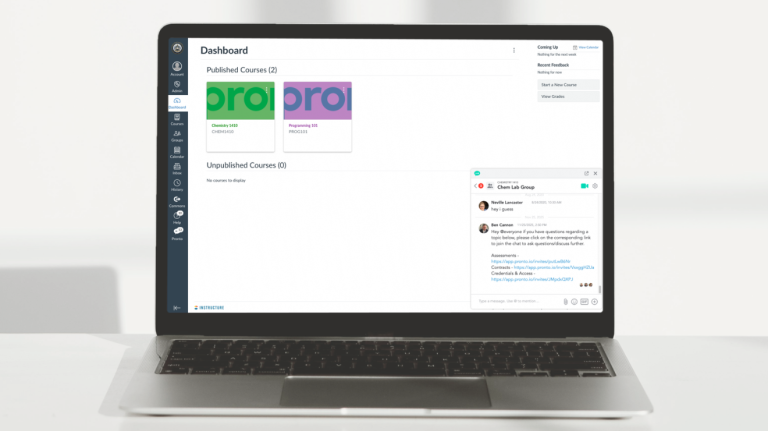
That’s the promise of the Canvas and Pronto integration: a communication layer that works inside the learning environment itself. By bringing real-time, mobile-first messaging directly into Canvas course structures, institutions can reach students where they already are — while maintaining the governance, visibility, and security that higher education requires.
And right now, that ability to reach students matters more than ever.
Because higher education has a communication problem.
The Communication Crisis No One Wants to Admit
When we speak with higher education leaders about the communication challenge higher ed is facing in not being able to reach students and the solution Pronto provides, the reaction is immediate. There’s rarely debate — only recognition. A chorus of head nods: “Yes. That’s exactly it.”
Students aren’t unreachable. They’re unreachable through legacy channels.
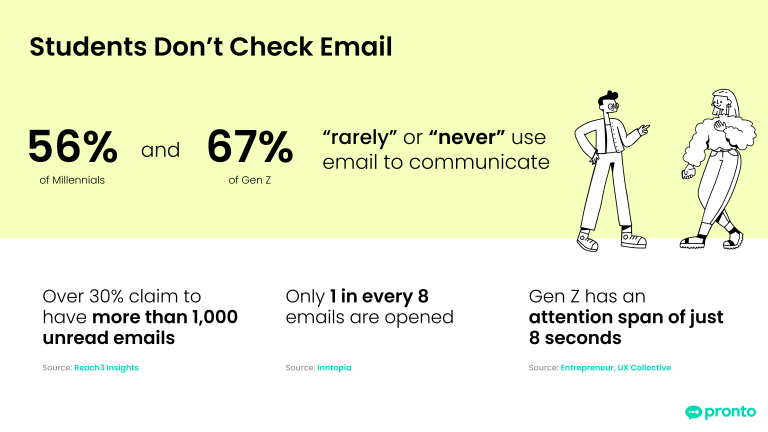
Email is the clearest example. According to Reach3 Insights, 56% of millennials and 67% of Gen Z rarely or never use email to communicate in daily life. The same research reports over 30% have more than 1,000 unread emails. And Intuit Mailchimp reports that only one in eight emails are opened. Email hasn’t disappeared — but as a real-time engagement channel, it’s become background noise.
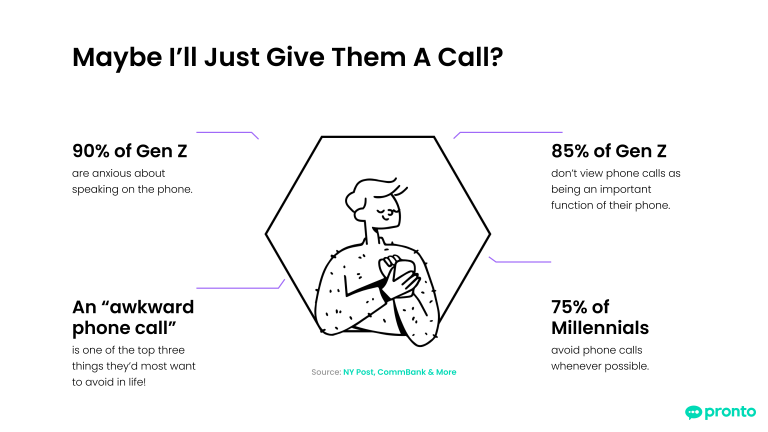
Phone calls are no better. The NY Post reports 90% of Gen Z experience anxiety about speaking on the phone. CommonBond reports 85% of Gen Z don’t view phone calls as an important function of their phone, and 75% of millennials avoid calls whenever possible. Calling often escalates an interaction rather than supports it. It interrupts. It creates friction.
SMS is frequently treated as the fallback option, but the channel is increasingly saturated. In November 2025 alone, 19.2 billion spam texts were sent in the U.S. — roughly 63 spam texts per person that month, according to Robokiller. Students are conditioned to ignore unfamiliar numbers.
So communication doesn’t disappear. It fragments — to Discord, WhatsApp, GroupMe, and personal texting.
Engagement moves, but governance doesn’t follow. These tools are rarely sanctioned, they aren’t designed around institutional control, and they expose colleges to serious risk.
Higher education doesn’t just have a messaging problem. It has a reach problem — and reach underpins engagement, compliance, and retention.
In the Age of AI, Belonging Wins
This is where the AI conversation becomes more nuanced.
AI can draft feedback. It can summarize lectures. It can automate administrative tasks. It can increase efficiency. But AI cannot replicate the feeling that someone noticed you. That someone responded quickly. That someone reached out before you quietly disengaged.
That feeling — that someone cares — is belonging. And belonging remains one of the strongest predictors of student persistence.
At Pronto, our mission is simple: strengthen learning and belonging by making communication effortless, inclusive, and immediate. Not to automate relationships, but to remove friction from them. In a world accelerating toward automation, the institutions that lead won’t be the ones that automate the most. They’ll be the ones that connect the best.
Why Pronto + Canvas Is the Best Communication Solution in Higher Education
Most institutions already have “communication tools.” That’s not the issue. The issue is alignment. Generic enterprise chat tools weren’t built for classrooms. Consumer apps weren’t built for compliance. Email wasn’t built for real-time student engagement. Higher education doesn’t need more tools — it needs communication that feels native to the learning experience and is governed like institutional infrastructure.
That’s the strategic advantage of Pronto + Canvas.
Canvas is where learning happens: assignments are submitted there, grades are checked there, modules are consumed there, and deadlines live there. Communication that sits outside the learning workflow becomes optional. Communication that integrates into it becomes structural.
Pronto integrates natively and deeply with Canvas, so course-based communication mirrors the reality of teaching and learning. Courses sync automatically, sections populate groups automatically, faculty communicate in context, and students engage within the academic ecosystem.
Institutions consistently describe that integration as essential.
At Long Beach City College, leaders shared:
“The Canvas integration is crucial for us. Pronto chat is secure and helps us move students away from non-secure apps.”
At Saddleback College, administrators said:
“Canvas and Pronto are integrated nicely. It’s the single solution students can use across classes that’s standardized and easy.”
At Cerritos College, faculty leadership noted:
“Students don’t check Canvas announcements or email — they check Pronto. And we can confirm who reads what, which is huge.”
This is what “best on the market” looks like in practice: communication that fits the academic workflow, feels natural to students, and stays institution-controlled.
Faculty Time Back: Classroom Chat as a Force Multiplier
There’s another advantage institutions talk about quietly — and value loudly: faculty time.
When communication is embedded directly within the course through the Canvas + Pronto integration, classroom chat becomes a learning multiplier. The dynamic shifts from one-to-one support — endless email threads — to one-to-many clarity where a single answer helps an entire class.
Students ask questions directly within their course chat. Peers often respond first, clarifying instructions, sharing notes, or helping one another prepare for exams. Instead of answering the same question 25 times over email, faculty can respond once in the course chat and the entire class benefits. Questions about assignments, deadlines, or exam preparation become visible conversations that everyone learns from.
Because Pronto mirrors Canvas course structures automatically, these discussions stay organized by class and section without additional setup from faculty. The result is communication that feels natural to students while dramatically reducing repetitive inbox work for instructors.
In practice, this means educators spend less time triaging email and more time teaching. Classroom chat becomes a space where students support each other, instructors guide discussion, and the entire course benefits from shared clarity.
That’s the advantage of the Canvas + Pronto model: communication that is integrated directly into the learning environment, helping students feel supported while giving faculty meaningful time back.
Secure, Governed, and FERPA-Conscious
When communication migrates to consumer platforms, institutions lose oversight. Open networks limit governance and institutional control unless operating at costly enterprise tiers — and even then, they aren’t purpose-built for higher education compliance.
Pronto and Canvas are designed for institutional control. Personal phone numbers aren’t exchanged.
Administrative oversight is centralized. Message transcripts can be accessed when needed. Read visibility provides documentation. The environment is Family Educational Rights and Privacy Act (FERPA)-conscious by design.
At Merced College, leadership put it plainly:
“Confidentiality is key. It’s a huge plus that Pronto is FERPA-compliant.”
And at Bakersfield College, administrators highlighted compliance support:
“Pronto has a Regular & Substantive Interaction (RSI) report that we love.”
In today’s regulatory environment, communication visibility isn’t a nice-to-have. It’s an operational necessity — especially for online programs where documenting Regular & Substantive Interaction matters.
Engagement That Mirrors Student Behavior
Students don’t respond to broadcasts. They respond to conversation.
Pronto feels like texting, but exists inside the Canvas LMS environment. That combination matters: it meets students where they are without sacrificing institutional oversight. It’s also why institutions report that
Pronto becomes the channel students actually check.
At Santa Monica College, administrators shared:
“Pronto is the best communications tool we have — more familiar to students and intuitive.”
And at Merced College, leaders reflected on its impact:
“If we didn’t have Pronto, I don’t think we would have kept the same number of students during the pandemic.”
When communication feels natural, students engage. When it feels formal and distant, they disengage.
Adoption Without Friction
Technology in higher education often fails for a simple reason: it’s complicated. If rollout takes months, training takes hours, and the experience feels clunky, adoption stalls.
Pronto works because it’s simple. It syncs with CanvasLMS rosters, groups form automatically, faculty adopt quickly, and students understand it immediately.
At Mount San Antonio College, administrators added:
“Pronto is one of our best vendors — easy to use, responsive, and consistently improving.”
Adoption doesn’t come from mandates. It comes from intuitive design that fits real campus life.
Retention Is a Communication Outcome
Enrollment pressure is real. Institutions that remove friction from communication see measurable impact.
At Strayer University, leadership stated:
“Clear ROI — Pronto influences students to stay in our classes and succeed.”
At San Diego Community College District, administrators described Pronto as:
“Mission-critical. Both students and faculty rely on it.”
Belonging drives persistence. Responsiveness builds clarity. Communication enables both.
Communication Is Infrastructure
Higher education is navigating enrollment volatility, compliance complexity, digital fatigue, and rapid technological change. Communication can no longer be treated as a background utility. It is infrastructure.
Infrastructure must be LMS-integrated, secure, mobile-first, simple, and purpose-built for higher education. Pronto strengthens Canvas by adding the communication layer institutions have been missing — not replacing the LMS, but reinforcing it.
The Greatest Risk Isn’t AI and Canvas + Pronto is the answer
AI will reshape learning.
But the greater risk facing higher education today is silence.
Silence between faculty and students.
Silence between advisors and struggling learners.
Silence between institutions and the people they serve.
In an age of automation, human connection becomes the differentiator. And connection begins with reach.
That’s why institutions are increasingly looking for communication tools that don’t sit outside the learning experience but live directly inside it. Through the native Canvas integration, Pronto adds a real-time communication layer that allows faculty, advisors, and students to connect within the course structures they already use.
Students aren’t unreachable. They’re just not reachable the old way.
To learn more about how Pronto integrates with Canvas to help institutions improve engagement, belonging, and retention, visit pronto.io/canvas.
Related Content
 rce_leaders_blog.jpg
Blogs
 adultify_blog.jpg
Blogs
Blogs