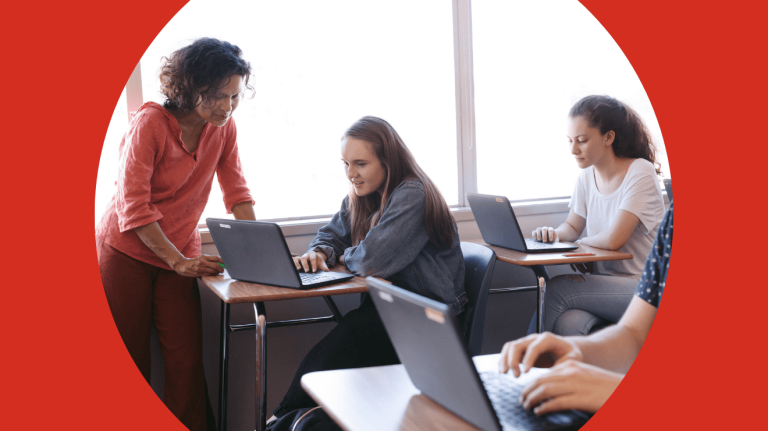
Baker Web Academy, a statewide virtual charter school in Oregon, has grown from roughly 300 students in 2012 to more than 4,500 today. Canvas by Instructure has served as the building for a school without one. Every one of its roughly 1,100 courses now runs on the same template, so students, families, and teachers have one consistent place for teaching and learning.
A school designed to meet every student where they are.
Baker is a statewide virtual charter school in Oregon that serves kindergarten through 12th grade, and its students log in from kitchen tables, living room couches, libraries, and the occasional bed right after waking up.
Personalization drives the Baker model. Every student works with an advisory teacher who acts as their liaison and learning coach, and the school offers a variety of courses so students can learn at the right level. "We really want to personalize students' learning, so we try to have different types of curriculum options, and meet students where they're at," said John Martin, curriculum director at Baker Web Academy.
Martin joined Baker as a math tutor in 2012, when the school had roughly 300 students. Today it serves over 4,500 students with about 300 employees, including subject-specific teachers and mental health counselors.
When Nicole Pratt, who now leads Canvas design and curriculum integration, arrived 10 years ago, Canvas usage was "very wild, wild west." Teachers used the learning management system (LMS) as far as their skills could take them. That was manageable with a few hundred students, but it created problems when the school grew to thousands. "As we started to grow, we needed better communication with our students, and consistency with things like contact information, expectations in the class, and pacing. We needed a common digital experience," Martin said.
What growth exposed:
- Every teacher built courses differently, so students had to learn multiple layouts and where to find contact information, expectations, assignments, and feedback.
- Enrollment grew faster than informal habits could keep up, especially when a surge of new students arrived in 2020.
- Teacher edits sometimes broke course setups, and with no shared baseline, every fix required extra work for the people supporting them.
Canvas functions as the school building.
The push for change came from teachers. In 2018, a few Baker teachers took on Canvas design roles because they could see where things were headed. "We had some teachers saying we have to formalize… this is getting too out of hand," Pratt said.
Those teachers understood that at a virtual school, Canvas isn't so much a tool as it is the classroom itself. "When it's time to do schoolwork, from their bed or kitchen table, students go to Canvas. All the courses are there, and it’s where they start planning their day," Pratt said.
We view Canvas as the building of our non-building school.
Nicole Pratt,
Canvas Design & Curriculum Integration, Baker Web Academy
And if Canvas was the building, it needed a floor plan everyone shared. That meant setting limits on what teachers could change in their own courses. "Things would get changed, and that would mess something up," Martin explained.
The flexibility of Canvas made that possible without giving up the personalization Baker was built on. "We like personalizing everything, and Canvas allowed us to create our own vision and what that might look like," Martin said.
One floor plan for every course.
Baker now runs about 1,100 Canvas courses across kindergarten through 12th grade. Every one opens to the same Baker homepage, syllabus, and institutional policies, and follows the same 18-week format, beginning with a Getting Started module. Only the course content changes.
Canvas gives students and teachers consistency. We're not all in the building together, but this is the common thread.
Nicole Pratt
Canvas Design & Curriculum Integration, Baker Web Academy
Baker built a template sandbox inside its own Canvas instance. Teachers start from pre-made homepages, assignment templates, accordions, and tabs, then fill them in. For curricula that work well with them, Baker also uses Blueprint courses so one main course feeds many sections.
As integrations with third-party curricula grew more complex, Baker's tech team took over the work of keeping courses aligned. The school also connected its student information system (SIS) to Canvas, which automates more of the work of enrolling students in courses.
Standardization also doubles as a training tool. Baker hires teachers at every level of comfort with technology, including veterans who've spent decades in traditional classrooms. A shared template gives every new teacher a place to start and build from.
Baker leaders also count on a steady relationship with Instructure. At InstructureCon and through the Canvas community, Pratt meets people who've solved similar challenges. And they see their customer success manager as an invaluable extension of their team. The CSM escalates support tickets, shares what's new, and listens when the team needs to talk through a problem. "He is a huge asset for us," Pratt said. "He's great at both taking feedback and offering insight."
What Baker Web Academy built:
• One shared template across 1,100+ Canvas courses
• A consistent starting point for a large-scale curriculum switch
• Automatic parent and learning coach observers in every course
• Canvas spaces for clubs, intervention classes, and live learning
• A 12-year-and-counting partnership with Instructure
What consistency makes possible.
The school recently moved away from a curriculum provider that about three-quarters of its students used and adopted a new one at scale. Instead of starting over, the team knew what every new course needed: the same templates, pacing, and grade passback it had already built.
Canvas also brings students together. High schoolers in career and technical education (CTE) pathways join Canvas courses for groups like health science, and other clubs, like Japanese Club, meet there as well. Some courses meet in Canvas for live Zoom classes, where they participate in discussions together.
After 12 years on Canvas, Baker isn't looking elsewhere. Even when curriculum providers have pushed a different LMS, the school sticks with Canvas.
Working with Canvas has been great. We have so much history there, and we keep getting more organized over time.
John Martin
Curriculum Director, Baker Web Academy
For other virtual schools considering Canvas, Pratt's advice starts with the same lessons Baker learned: standardize templates, align grading schemes from the start, attach observers automatically, and use Blueprint courses where the curricula allow.
Next, Martin and Pratt want a clearer picture of every staff member's Canvas skills, from first-time users to early adopters, so training meets each person where they are. Just as Baker personalizes learning for every student, it wants training to work the same way for every educator.
Enrollment, staff, and curricula have all changed since 2014, but Baker's building hasn't. It's still Canvas, and it's still where every student starts the day.
Choosing an LMS that can grow with you?