
It is no secret that higher education leaders are operating under immense pressure. They’re being asked to deliver more to a diversifying student population with heightened expectations. At the same time, the old foundations including predictable enrollment patterns, steady funding and the unquestioned importance of the traditional degree, are beginning to crack.
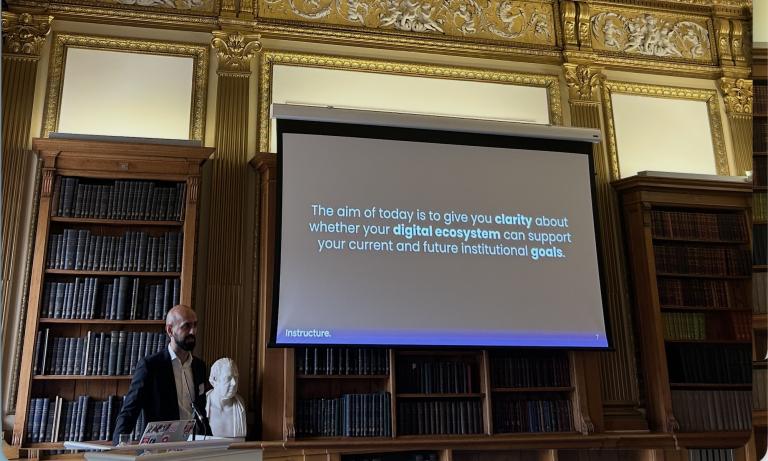
This was the backdrop for a private roundtable hosted by Sidharth Oberoi (VP Global Strategy at Instructure) at the Royal Society on March 31, 2026. Opinions varied among the fifteen leaders, but they were able to agree on one point: to thrive in the coming years, the sector must trade cautious hesitation for decisive action. To that end, the discussion centered on three critical shifts which require the most urgent action.
1. The value question is getting louder
One of the strongest themes to emerge was a growing tension around value, in terms of how it is defined and delivered to today’s student.
Leaders consistently pointed to a shift in student expectations, many of whom are not only comparing institutions to one another, but to the seamless, personalised digital experiences they encounter elsewhere.
At the same time, institutions are facing:
- Increased competition for students and rising recruitment costs
- Greater scrutiny over the return on investment of a degree
- Pressure to deliver flexible, career-aligned learning pathways
- Fragmented technology environments that make transformation harder to execute
Live polling reinforced the scale of the challenge. Leaders highlighted:
- Erosion of trust in traditional higher education models
- A perceived lack of value for money
- Risk aversion and limited entrepreneurial mindset across the sector
- Growing competition from alternative providers, including commercial
There was also a clear debate: Should institutions expand into new models such as microcredentials and flexible pathways, or focus on fewer areas of strength and differentiate more clearly?
Key takeaway: Institutions that can clearly adapt their offering to their target students, and articulate their unique value, will be best positioned to compete in an increasingly crowded and sceptical market.
2. AI adoption is outrunning strategy
If there was one area where urgency was most visible, it was AI. While AI adoption is accelerating, it’s often driven by students and individual educators. Many institutions acknowledged that they were lacking a top-down AI strategy, and that their institution had been more reactive to AI thus far.
The discussion surfaced a number of tensions:
- How can we balance innovation with risk - how far do we go, how fast, and under what guardrails?
- AI literacy must go beyond technical skills. Students and staff need to understand when to use AI and when to rely on human thinking.
Polling revealed a lack of consistency and confidence in current approaches:
- Many institutions do not yet have a clearly defined or transparent AI strategy
- Students are often more advanced in their use of AI than faculty
- Staff training and institutional guidance are still evolving
- AI adoption is, in some cases, happening without clear purpose or alignment
Key takeaway: Institutions need to move from experimentation to intentionality, developing and communicating a pedagogically grounded approach to AI.
3. Resilience requires letting go
As the threat to resilience becomes clearer for most higher education leaders, many are still defining what it actually means to be resilient enough to survive the next decade. There was strong alignment on the need to evolve, but less clarity on how quickly and how far to go.
Leaders highlighted several areas of focus:
- Expanding into microcredentials and alternative recognition models
- Strengthening industry partnerships and employability pathways
- Investing in emerging disciplines and future-focused research
- Delivering high-quality online and in-person experiences—without trying to replicate one in the other
However, structural barriers continue to slow progress:
- Bureaucracy and compliance frameworks limiting agility
- A culture that does not easily tolerate failure
- Underutilisation of data for strategic decision-making
Polling responses were particularly candid:
- Some institutions admitted they are not yet actively building resilience
- Others emphasised the importance of creating cultures where failure is shared and learned from
There was also a fundamental question underpinning the discussion: Is the traditional degree still the primary signal of value, or is the balance shifting toward skills and employability?
Key takeaway: Resilience requires simplifying systems, embracing change, and making deliberate choices about where to play and how to win.
Simply put, these discussions were defined by a sense of self-awareness and pragmatic urgency.
In practice, this urgency means more than just adopting new tools. It means building an educational offering that remains competitive, roots AI adoption in sound pedagogy and aligns with the realities of the modern workforce. In doing this, leaders can move beyond merely reacting to change and begin to actively shape the future of the sector.
These insights are drawn from a private roundtable hosted by Instructure on March 31, 2026, at the Royal Society, London, conducted under Chatham House Rules.

Related Content
 1000141729.jpg
Blogs
 instructure_2022-may_cofi-372.jpg
Blogs
 inst-default
Blogs